

Coyote Weather

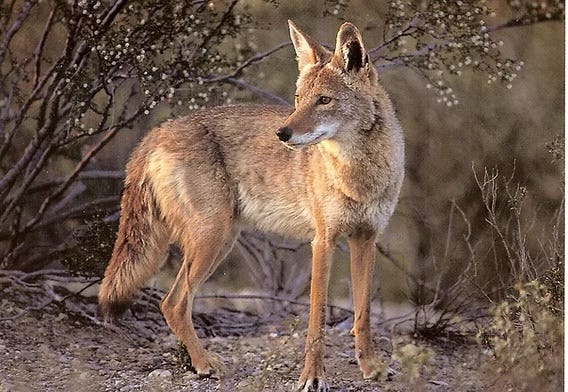
It is pitch black and cold outside as I make my way down the mountain after my final night class has ended. I like people, but after seminar, after doing mental gymnastics over some of the most difficult, and most profound, books ever written, I’m not in the mood for company. I want to walk by myself, feel the air on my face, taste the sage and juniper on the night breeze. So, I walk alone, putting distance between myself and my classmates. But I’m not alone. I can hear them in the tall grasses on either side of me, keeping pace. They’ve done this all year, I have a feeling they are escorting me out of their territory before the moon gets any higher, before their hunting and their singing really begin. They never get too close, but every now and then a car winds its way up the drive, and they are illuminated in the headlights, coyotes, accompanying me down the mountain. They did this all year. They did it, I think, for most of the students who had class up in that lone classroom, I just think most of the kids didn’t notice. Coyotes are, after all, known to be sneaky. Hard to spot. Elusive.
It’s high noon. My beloved and I are walking hand in hand around Stowe Lake in Golden Gate Park. We ignore the hissing Canadian Geese as we meander down a more wooded part of the trail. And then we stop. Maybe 5 feet in front of us is a coyote. She carries a very large and very dead duck, snapped tight between her sharp teeth. She looks at us with that look that says STOP NOW. I know it. She is moving with care, and I see that her nipples are swollen and oozing milk. She has a den of pups, not far away, and she is bringing dinner home. We back away. Slowly. Leaving her to her work. As we backtrack, we come across a young couple with a little dog that is off leash. I tell them that there is a mother coyote down the trail with a fresh kill and that they need to leash their (very small) dog. They smile and say, “how exciting!” and keep on walking, ignoring my advice. A few minutes later we hear the howls of that dog, sounding like it is hurt, and then nothing. My love and I look at each other wide-eyed. We tried to warn them…sometimes that’s all you can do. Coyotes are deceptive. Beautiful, yes. Familiar to urbanites, yes. Domesticated, never.
It is early morning in the Sangre de Cristos. Still mostly dark. The blazing New Mexico sun is not up yet. Mist lies over everything, softening the land. We are driving down the road getting started on a long journey when we see them. Two coyotes down in the center of town, playing together. Play bow, wagging tail, lolling tongue, jump, spin, repeat. But they are not alone. There are two ravens hanging out in the trees above them, also playing. The birds will feint a dive, pulling up at the last minute as the coyotes spring up on their haunches trying to catch them in mid-air, and then roll around on their backs with their paws up in the air while the ravens look down on them and issue their cackle call laughs. Coyotes are tricky. Frisky. Funny and fun-loving. Keenly aware. Connected.
It is still Winter where I live so I still have some time to tell Coyote stories, for they may only be told in Winter. And we are entering a time when these stories may be of particular import. As I wrote in Full Fathom, this past week has brought us some significant moments…including one that hasn’t been seen in over 9,000 years. These moments, taken together, may signify the crumbling away of something old and the birth of something entirely new. You can feel this shift too, I am sure, taste it on your tongue. It ushers in a certain kind of weather, one we might call Coyote Weather. Because, as I’ve illustrated with my stories above, Coyote may be the perfect energy to embody as we encounter, as we construct, this new world.
Coyote is known in story as the Trickster, the one who is clever and a thief when required, a gifted story-teller, an able liar. Coyote stands on his head (although in nature coyotes are typically matrifocal, in story Coyote is always a guy) with one eye winking, telling dirty jokes—and somehow sees the situation more clearly than the most earnest-hearted hero. Coyote goes to steal the Sun, the Moon, the Gold, the Fire, ends up being led around by his dick (literally sometimes his penis jumps off and does a dance and he has to try to catch it), winds up falling into a cactus patch or a cauldron of red hot chile and yet manages to come out on top. Coyote is a rascal and unreliable and weirdly, more often than not, Coyote comes through. These stories mirror what we see from actual Coyotes, well, more or less.
Coyotes are one of the most highly adaptable animals in the world. They are, what we might call in economics, counter-cyclical. Large predators have an inverse relationship to human populations. As human populations increase, large, keystone predators such as wolves and cougars decrease. All large predators except Coyotes. They broke the code. As people increase, so do they. Why? How? People try to excuse this contradiction by taking the quality of predator away from them. They will say Coyotes are not true predators, they are scavengers and that’s different. Turns out, Coyote’s key to survival is more complicated that a single classification and comes down to one word: Adaptability. And what quality are you going to need for the times ahead? Same word. You can see Coyote’s adaptability in the three stories I told…same animals, three radically different ways of being in the world. There are tricks within that adaptability that it might serve us to study at this moment.
The first is range.
Coyotes originally inhabited the prairies and deserts of central North America, but they’ve dramatically expanded their range over the past century. They now live in every US state except Hawaii and have spread into Central America and as far north as Alaska. This expansion actually accelerated as wolves were eliminated, since wolves are their primary natural competitor. This range expansion includes moving into unlikely environments…like cities. Coyotes thrive in cities, including Chicago, Los Angeles, San Francisco and New York…we even have them in San Antonio. Urban coyotes have learned to navigate traffic, shift to nocturnal activity to avoid humans, and exploit human food sources like garbage, pet food, and fruit trees. Chicago’s Urban Coyote Research Project has tracked over a thousand coyotes living successfully within city limits. What’s your current range? Does it need to change or expand?
They pair range with another vital quality: flexibility and it shows up in multiple areas of life, starting with diet. Coyotes are true omnivores and opportunistic feeders. They are true predators…just as much as a wolf or a cougar. They are also not above scavenging. Their priority after all is survival. Their diet can include rabbits, rodents, deer, insects, fruits, vegetables, carrion, and human refuse. They adjust their diet seasonally and based on whatever is locally abundant, which is a huge factor in their success. Dietary flexibility extends to social networks as well. Coyotes can live as solitary individuals, in pairs, or in loose packs, depending on food availability and population density. This social plasticity lets them succeed in a wide range of environments. Flexibility requires awareness and responsiveness, and we see this most clearly illustrated in the ways that Coyotes do (or don’t) reproduce. When coyote populations are heavily hunted or culled, they compensate by producing larger litters and breeding at younger ages. Females in pressured populations may have litters of 10+ pups instead of the typical 5–7. This makes them notoriously difficult to control through lethal means. They know how to increase the odds in their favor. In the eastern US and Canada, coyotes have hybridized with wolves and domestic dogs, producing larger animals sometimes called “coywolves.” These hybrids may be even better suited to eastern forests and urban environments than pure coyotes. Where is life asking you to be more aware? More responsive? More flexible?
And here is the final trick, the one that holds all the others together: Coyote survives because Coyote refuses to be pinned down. You cannot predict what Coyote will do next because Coyote doesn’t decide until he’s in the situation, reading the terrain, sniffing the wind, assessing the threat. He is not rigid. He is not ideologically trapped. He does not cling to the way things were or insist that circumstances bend to his preferences. He meets the world as it is and then…quick, clever, sometimes absurd…he moves. Another way to say it? Coyote learns.
This is what Coyote Weather asks of us. Not that we become tricksters in the sense of being dishonest or unreliable, but that we become adaptable in the way that only those who are paying close attention can be. That we expand our range when necessary. That we adjust our diet, literal and metaphorical, based on what is actually available rather than what we wish were on the menu. That we stay curious, not assuming that we know the answers, but looking instead for the best questions to ask, because curiosity lends itself to learning, which. in turn leads us to the best kind of flexibility.
The world is shifting. We can feel it. Something old is crumbling and something new is being born and none of us know exactly what shape it will take. In times like these, the earnest hero with his fixed quest and his noble ideals often falls short, missing the mark. But Coyote? Coyote comes through. Muddy, singed, a little ridiculous, probably missing part of his bushy tail from the last scrape…but alive. Thriving, even.
So, here is my question for you as we move deeper into Coyote Weather: Where do you need to be more like Coyote? Where have you been too rigid, too attached, too unwilling to shift or to learn? And where might a little trickster energy…clever, adaptable, refusing to be pinned down...serve you well in the days ahead?
The moon is rising. The song is starting. Time to dance.
xoxo,
Bri
P.S. All of the shifts we have experienced this week have probably brought up a lot of feelings for you…Coyote weather does that. If grief is one of those feelings then I have some good news for you…right now IS the seaason of grief, the “Shining Sadness” as the Orthodox call it, and we have a ceremony for that.
Very apt for this week and as I look for new work challenges me to expand where I think I will end up. Thanks for your writings!
I'm taking a dance class starting tomorrow, after a couple years not attending, with lots of new aches and pains, but I'm excited to roll with the punches. Your words felt perfectly aligned, especially the very end. 😄